
Blog: Bobsla –
Innovation meets Winter Sports
27.03.2026
Shark Tank of Patents
The well-known start-up show "Die Höhle der Löwen" (The Lion's Den / Shark Tank) regularly presents innovative products that rethink existing markets or open up completely new areas of application.
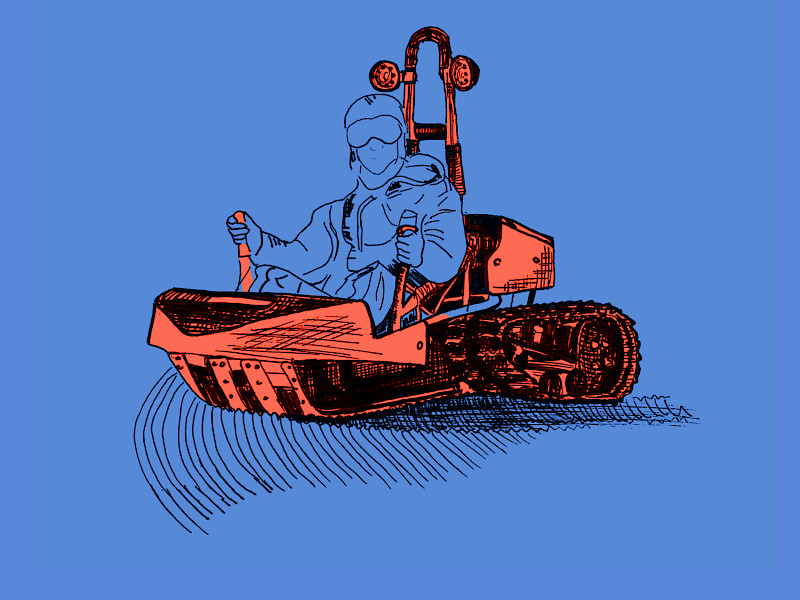
With Bobsla, a start-up ventured into previously unexplored territory: an electric, lightweight, and intuitively controllable snowmobile that combines winter sports, sustainability, and modern design.
Bobsla is not only aimed at extreme athletes, but at a broad target group – from winter sports enthusiasts and tourism businesses to outdoor fans who want to travel emission-free and quietly in the snow.
Appearing on "Die Höhle der Löwen" gave Bobsla exactly the attention a hardware-based start-up needs. On the show, the founders were able to not only present their product but also convey their vision of sustainable winter sports.
"Die Höhle der Löwen" offers young companies much more than just capital:
media reach, strategic know-how, and access to networks are often the decisive leverage for successfully establishing innovative products on the market.
The idea behind Bobsla
The founders of Bobsla had a clear goal: to redefine snowmobiling. Traditional snowmobiles are loud, heavy, maintenance-intensive, and mostly powered by combustion engines. At the same time, awareness of sustainable mobility concepts is growing–including in the leisure and tourism sectors.
This is where Bobsla comes in: a compact, electric snow vehicle that is easy to transport, intuitive to operate, and completely emission-free. The vision behind it is to make winter sports more accessible, quieter, and more environmentally friendly – without sacrificing driving pleasure.
Electric snowmobiles and winter sports:
What is already available?
The snowmobile market has traditionally been dominated by large, heavy gasoline-powered vehicles. Electric alternatives are still rare and often either very expensive or limited to special professional applications.
An overview of well-known alternatives:
- Classic snowmobiles: High performance, but loud, heavy, and high in emissions
- Snowbikes & skibobs: Sporty, but physically demanding and not motorized
- Electric prototypes: Often heavy, complex, or not ready for series production
Bobsla positions itself between these worlds, combining electric drive, low weight, and easy handling in one product.
What makes Bobsla special?
Bobsla is impressed with a number of clear unique selling points:
- Electric drive: Quiet, emission-free, and low-maintenance
- Compact and lightweight design: Easy to transport, even in the trunk
- Intuitive controls: Low barrier to entry, also suitable for beginners
- Modular construction: Focus on functionality and suitability for everyday use
- Sustainability: No gasoline, no oil, no exhaust fumes
- Versatile use: Leisure, winter sports areas, rental, tourism
Bobsla opens up new opportunities for ski resorts and tourism providers in particular to offer silent winter experiences without harming nature and the environment.
Bobsla patent application (EP3802304A1)
The Bobsla patent application relates to a motorized snow or ice vehicle with a body 1, a sliding surface 2 arranged on the underside of the body 1, a first wheel 3 (or first endless running belt) on one side of the vehicle, and a second wheel 3' (or second endless running belt) on the opposite side of the vehicle (see Figs. 1 and 2 of the Bobsla patent application). The central feature of the Bobsla patent application is that the sliding surface 2 is always in contact with the ground, regardless of whether the wheels 3, 3' (or endless running belts) are raised or lowered. The sliding surface 2 is formed entirely by the body 1 and is located at the front of the snow/ice vehicle, while the wheels or endless running belts are located at the rear of the snow/ice vehicle.
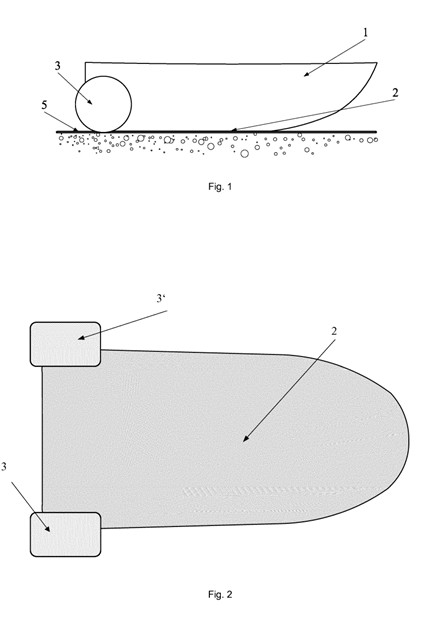
[Figs. 1 and 2 of the Bobsla patent application]
CN201165242Y (D1) relates to an electric ice vehicle with a housing body 1, on the underside of which ice blades 6 are arranged (see Figs. 1 and 2 of D1). Two lateral drive units each drive rollers via chains, which interact with laterally arranged running belts. The ice blades 6 represent point sliding elements; the housing body 1 itself is not designed as a continuous sliding surface that is in permanent contact with the ground regardless of the condition of the chassis.
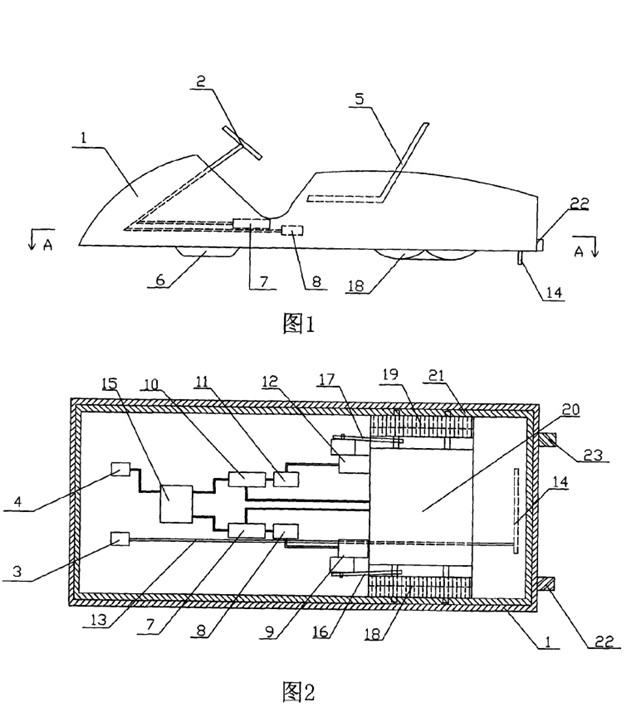
[Figs. 1 and 2 of D1]
US2967578A (D2) describes a vehicle with an endless running belt with support and drive units 25, several support wheels 17, a longitudinal frame element 14, and complex suspension and drive mechanisms for tilting and height adjustment of the endless running belts (see Figs. 1 to 4 of D2). The focus is on adjustable chassis structures and mechanical, hydraulic, or joint-based power transmission.
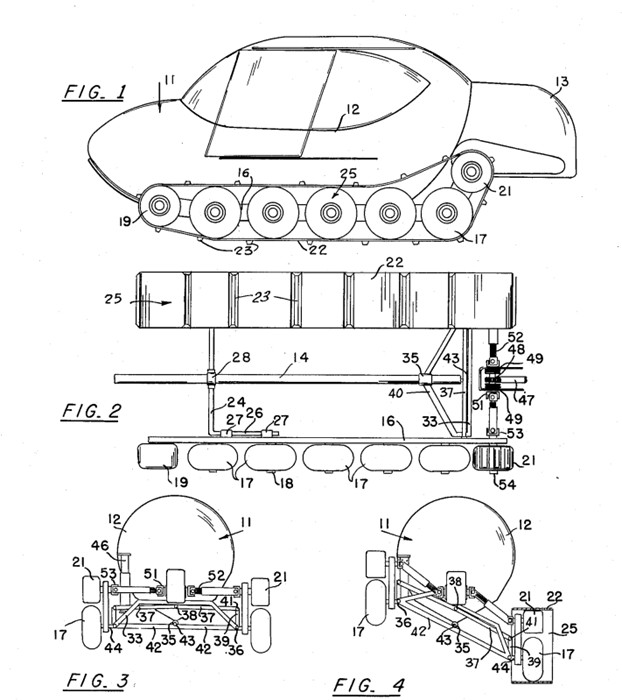
[Figs. 1 to 4 of D2]
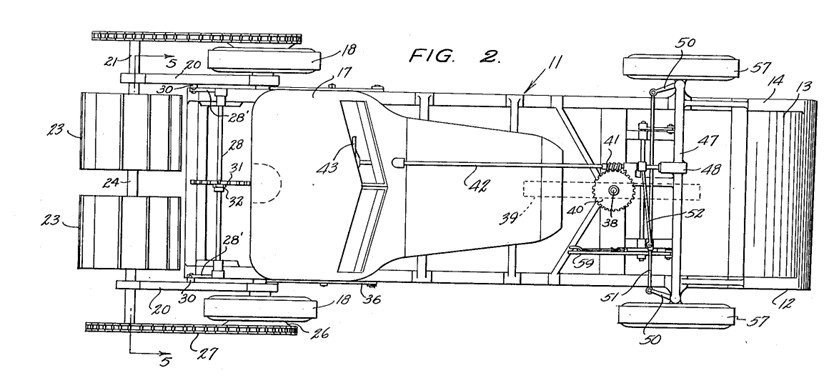
US2683608A (D9) discloses a combined snow and road vehicle with rear wheels 18 and additional snow shovel wheels 23 arranged at the rear of the vehicle (see Fig. 2 of D9). The snow shovel wheels 23 can be raised and lowered relative to the vehicle body 2 via steering and lever mechanisms. The vehicle body is not designed as a continuous sliding surface that always has contact with the ground regardless of the chassis condition.
[Fig. 2 of D9]
The decisive technical difference in the Bobsla patent application is that the sliding surface 2 of the body 1 is always in contact with the ground and forms the load-bearing ground contact element of the vehicle, regardless of the position of the wheels 3, 3' (or endless running belts). In D1, ground contact is made via point ice blades 6, in D2 via endless running belts 22, and in D9 via wheels 18 or snow shovel wheels 23, whereby the respective vehicle body is not designed as a continuous sliding surface that is in constant contact with the ground. In contrast, in the Bobsla patent application, the sliding surface 2 of the body 1 remains in permanent contact with the ground, while the wheels 3, 3' (or endless running belts) are intended exclusively for propulsion, steering, and braking and do not replace the ground contact of the sliding surface 2.
Conclusion
Bobsla is a prime example of a new generation of winter sports products: electric, sustainable, and user-friendly. The start-up shows that innovation is also possible in traditional markets such as the snowmobile segment – and that driving pleasure and environmental awareness are not mutually exclusive.
The appearance on "Die Höhle der Löwen" marks an important milestone on the road to market penetration. With a clear focus on design, technology, and sustainability, Bobsla has the potential to change winter sports in the long term.
For IP made in Germany® – contact us.

Disclaimer: The above contribution reflects the personal opinion of the author. The assessments and statements made in the article do not constitute legal advice and are provided under exclusion of any liability. If you need an assessment of an individual case, please contact the author and/or the law firm KUHNEN & WACKER.
その他のニュースや
K&Wからの情報



K&Wでキャリアをスタートさせ、チームの一員になりませんか?
チャレンジ精神と柔軟性に富んでいると自覚していますか?自分から率先して責任のある仕事に係わりたいですか?それなら当事務所は最適な職場です。